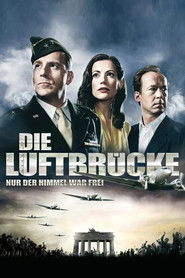
Two-part historic drama about a difficult love affair between a German woman and an American soldier during the Berlin Airlift. After her husband Axel is declared dead, Luise Kielberg must survive as a single mother of a 12-year-old boy in post-war Berlin. At the beginning of the Soviet Blockade in 1948, she waitresses at the Tempelhof Airport and gets to know General William Turner, one of the most influential aides of General Clay to organize the American airlifts. Luise becomes his personal secretary and falls in love with him, but suddenly Axel returns.
It's the spring of 1944 and Therese is in a hurry to get back to Paris. The trains aren't running from the village where she has gone to visit her father's grave and to fill two suitcases with food. Some British and American planes have been shot down and the Germans want to know where the pilots are hiding. An acquaintance has clearance to drive to Paris with a truckload of goats. After she is in the truck Therese discovers that two British pilots and an American pilot are back there with the goats. She must get the men on a train to Paris and to a safe house there, where there is no room for the American. Can she leave him at the Metro station trying to figure out the map?
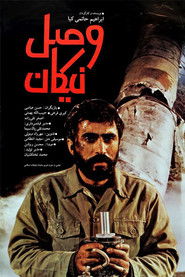
Amir, who defuses missiles that fall on Iranian territory, insists on celebrating his wedding despite the dangerous situation made by the Iran-Iraq War.
Filmed in the skies above France and the United States, The Lafayette Escadrille tells the story of the American volunteers who flew and fought for France in World War 1, becoming the founding squadron of American combat aviation.
Standing on the very shores where Allied soldiers stormed the beach to liberate Europe from the clutches of Nazi Germany, Ronald Reagan gives a speech to D-Day veterans and world leaders.
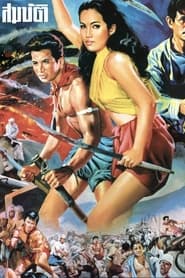
This movie is about Bang Rajan village. This village is located north of Ayutthaya, the old capital of Siam, predecessor state to modern Thailand. The village played a famous role related to its resistance against the Burmese in the war that saw the destruction of Ayutthaya city in 1767. Tap is a Siamese soldier leader. Siamese people have internal conflicts while they are also fighting with Burma.
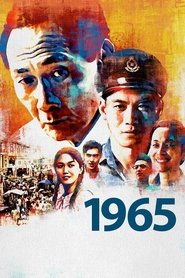
A dramatic thriller that tells the engaging and touching stories of immigrants and natives during the time leading up to the independence of Singapore. The protagonists were a part of history in the making; they become the pioneer generation who live to see beyond the prejudice and fear of racial hatred and ultimately face the challenge of nation building - a mirror reflecting the fragility of racial harmony in our world today.
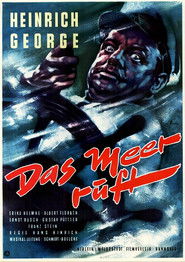
The Baltic captain Terje Wiggen works as a pilot on the island of Muhu. When the mate of the ship “Carola” calls in sick, he jumps at the chance of reviving his life as a sailor. WWI breaks soon after the departure. By and by the ship’s company gets worn down by dead calm. On account of the plague-ridden captain, Wiggen disposes of the contaminated water reserve. Discontent among the crew rises until they take the sole lifeboat and leave their mate behind. Wiggen unsuccessfully tries to bring the ship under control. At the last minute he is rescued off the Japanese coast. At his return he promises to never leave his wife and child again. But the German Imperial Navy begins to blockade the waterways of the island. Wiggen paddles to Sweden with the intention of smuggling provisions for his family. On his way back he is detained by a German captain. After five years of imprisonment he returns to Muhu once more. Wiggen is hellbent on vengeance. (Deutsche Kinemathek)
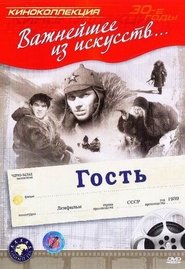
A young Nenets hunter exposes a saboteur who has infiltrated the territory of the USSR, who at first poses as a doctor who has gone astray, and then makes the hunter his hostage.
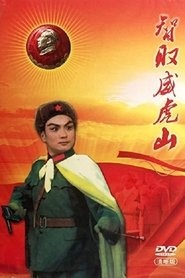
Taking Tiger Mountain was the very first model film produced during the Chinese Cultural Revolution (1966-1976). Set during the civil war in 1946, it follows a detachment of the People's Liberation Army in Mandchuria as they are fighting a group of bandits hiding in the mountains. Based on a novel from the 50s, Taking Tiger Mountain was first a revolutionary opera before being made into film by director Xie Tieli.
The Mediterranean movie directed by Hadi Hajatmand and produced by Rashid Hajatmand, (ShowBox), starring Mehraveh Sharifinia, Behrang Alavi and Pouria Poursorkh, was released in cinemas across the country in 1400. Saberullah Dadian has written this film. Synopsis: Hadi Hajatmand's second feature film has a social theme and deals with the life of a loving couple who are involved in various problems and adventures...
March 1945. It is already quite obvious to the Nazis that they cannot win the war. So it is time to think about the future after the war and to cover their tracks. One concentration camp must be completely cleared out and the prisoners buried in the mines. Only the mine-hunters remain - among them Ernest, a veteran of the Spanish Civil War from Vienna, and Kim, a resistance fighter from Prague. One day they decide to escape with the other prisoners, but they are betrayed and most of the escapees are shot. The pair of heroes are not alone, however, and on the way they are joined by a guard dog from the camp that Kim used to feed. In the coming days, Ernest leads young Kim through the unrelenting cold on his journey to freedom, teaching him that there is only one rule to follow in this time - kill or be killed.
We have detected that you are using an ad blocker. In order to view this page please disable your ad blocker or whitelist this site from your ad blocker. Thanks!