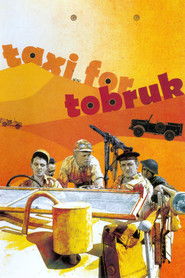
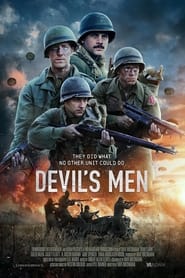
A by-the-book Captain is ordered to capture a strategic village in Italy. The Italian soldiers are willing to surrender, if they can have a festival first. The lieutenant convinces the Captain this is the only way. Because of aerial reconnaissance, they must look like they are fighting. To sort this out an intelligence officer is sent in. Meanwhile the festival gets complicated with the Mayors daughter.
WWII is entering its last phase: Germany is in ruins, but does not yield. The US army lacks crucial knowledge about the German units operating on the opposite side of the Rhine, and decides to send two German prisoners to gather information. The scheme is risky: the Gestapo retains a terribly efficient network to identify and capture spies and deserters. Moreover, it is not clear that "Tiger", who does not mind any dirty work as long as the price is right, and war-weary "Happy", who might be easily betrayed by his feelings, are dependable agents. After Tiger and another American agent are successfully infiltrated, Happy is parachuted in Bavaria. His duty: find out the whereabouts of a powerful German armored unit moving towards the western front.
This five part epic war drama gives a dramatized detailed account of Soviet Union's war against Nazi Germany during world war two. Each of the five parts represents a separate major eastern front campaign.
This sequel to "The Bastard" continues the saga of Philip Kent, the illegitimate son of an English nobleman, who has renounced his patrician birthright to become a Colonial soldier fighting for America's independence, befriending a Southern aristocrat and his earthy buddy to help thwart a plot to assassinate George Washington. (Episodes 3 and 4 of the Kent Chronicles miniseries.)
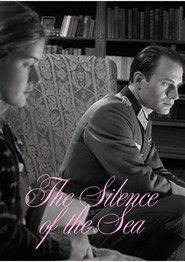
In a small town in the West of France, during the German Occupation, a room is requisitioned by a Wehrmacht captain, Werner von Ebrennac. The house where he now stays is inhabited by young Jeanne, who makes a living by giving piano lessons, and by her grandfather. Quite upset, the two "hosts" decide to resist the occupier by never speaking a word to him. Now Werner is a lover of France and its culture, and he tries to persuade them that a rapprochement between Germany and France would be beneficial for the two nations. Quite unexpectedly Jeanne, little by little, falls in love with Werner. At the same time, the Francophile officer loses his illusions, realizing at last that what Nazi Germany actually wants is to thrall France and to stifle its culture...
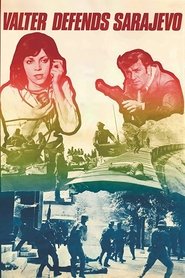
Sarajevo 1944. The German armies desperately need fuel in the retreat. Walter, the enigmatic and charismatic leader of the resistance movement, can endanger their supplies. The Germans are taking a cunning plan to remove that obstacle.
Wu Qing Qing, the young master of the Wolong Gang, has been betrayed after her family's massacre. From prey to hunter, she transforms into a hunter. Hidden in the shadows, behind every smile may lie a deadly dagger. A Japanese trading company infiltrates her inner circle, a mole is hidden among her closest relatives, and a web of intrigue unfolds. Trust is a luxury; every step is a precipice! How will she tear off those masks of hypocrisy? Is the traitor a member of the gang, an invading enemy, or even her own husband? The storm has arrived; "eliminating the traitor" becomes the only creed…
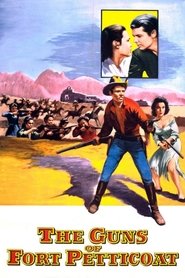
Opposing his commanding officer's decision to attack a group of innocent Indians and wipe them out, Lt. Frank Hewitt leaves his post and heads home to Texas. He knows that the attack will send all of the tribes on the warpath and he wants to forewarn everyone. He gets a chilly reception back home however. With most of the men away having enlisted in the Confederate army Frank, a Union officer, is seen by the local women as a traitor. He convinces them of the danger that lies ahead and trains them to repel the attack that will eventually come.
The horrors of war through the eyes of a real WWII soldier who helped form our special forces. Sam Byrne was a Wyoming ranch boy drafted into doing his duty, even though he was a deeply religious man who didn’t believe in killing. Unwilling to kill, he quickly learns how to adapt, eventually saving many of his platoon in the Battle of Anzio and showing the heart of a hero.
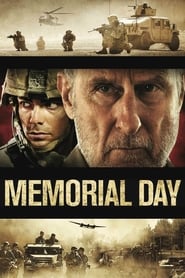
Memorial Day, 1993. When 13-year-old Kyle Vogel discovers the World War II footlocker belonging to his grandfather, Bud, everyone tells Kyle to put it back. Luckily, he ignores them. Although Bud has never talked about the war, he finds himself striking a deal with his grandson: Kyle can pick any three souvenirs, and Bud will tell him the stories behind each one. Memorial Day not only takes us on a journey into Bud's complicated wartime past, but also into Kyle's wartime future. As the two men share parallel experiences in combat, they come to realize how that magical day on the porch shaped both of their lives.
In Nazi-occupied Paris, a young accompanist named Sophie Vasseur gets a job with famed singer Irene Brice. As Irene's husband Charles, a businessman collaborating with the Nazis, wrestles with his conscience, Sophie becomes obsessed with Irene, taking on the role of maid as well as accompanist, living life vicariously through Irene's triumphs and affairs.
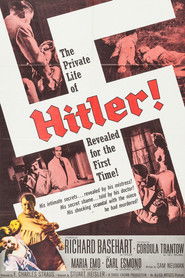
Richard Basehart stars as one of the most influential and one of the most reviled men in history in this probing psychological study of a man who nearly gained dominance over the entire western world--at the cost of millions of lives--Hitler.
After Shideh's building is hit by a missile during the Iran-Iraq War, a superstitious neighbor suggests that the missile was cursed and might be carrying malevolent Middle-Eastern spirits. She becomes convinced a supernatural force within the building is attempting to possess her daughter Dorsa, and she has no choice but to confront these forces if she is to save her daughter and herself.
In a small town in Nazi-occupied Slovakia during World War II, decent but timid carpenter Tono is named "Aryan comptroller" of a button store owned by an old Jewish widow, Rozalie. Since the post comes with a salary and standing in the town's corrupt hierarchy, Tono wrestles with greed and guilt as he and Rozalie gradually befriend each other. When the authorities order all Jews in town to be rounded up, Tono faces a moral dilemma unlike any he's known before.
A teenage boy's best friend disappears during the army's intensified anti-terrorist activities in Kashmir in 1993, and he will do anything to find him, even if it means sacrificing himself.
We have detected that you are using an ad blocker. In order to view this page please disable your ad blocker or whitelist this site from your ad blocker. Thanks!