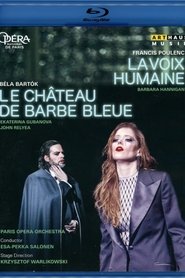
Running through Bartók’s disenchanted tale, whose haunting music was initially condemned as unplayable, and the expression of despair in Poulenc’s monologue, the director Krzysztof Warlikowski perceives a shared dramatic thread, a shared feminine consciousness and a shared sense of imprisonment and suffocation: for the woman who penetrates the confines of Bluebeard’s castle and Elle, the woman who clings to a telephone conversation with a man as the only thing worth living for, are condemned to share the same fate. And this man she speaks to, does he really exist? Unless the director has interpreted Cocteau’s words to the letter and the telephone has become a “terrifying weapon that leaves no trace, makes no noise”…
Unfortunately the movie Poulenc's The Human Voice / Bartók's Bluebeard's Castle is not yet available on Netflix. Follow us on Facebook to see when Poulenc's The Human Voice / Bartók's Bluebeard's Castle becomes available on Netflix!





| Production | Laurent Métivier | Producer |
| Directing | Stéphane Metge | Director |
| Directing | Krzysztof Warlikowski | Stage Director |
| Production | Denis Morlière | Producer |
| Directing | Stéphane Lissner | Director |
| Art | Małgorzata Szczęśniak | Set Designer |
| Production | Antoine Perset | Producer |
| Lighting | Felice Ross | Lighting Design |
| Sound | Béla Bartók | Music |
| Sound | Francis Poulenc | Music |
| Writing | Béla Balázs | Writer |
| Writing | Jean Cocteau | Writer |







We have detected that you are using an ad blocker. In order to view this page please disable your ad blocker or whitelist this site from your ad blocker. Thanks!